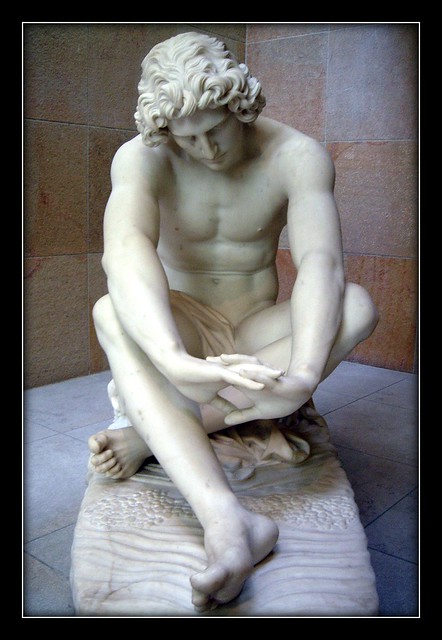
Jean-Joseph Perraud statue, Le Desespoir ( the Despair) was first conducted in 1861 and then marble plaster and then in 1869 it was presented at the Salon, beginning in 1725 the official art exhibition of the Academie des Beaux-Arts in Paris, France. Le Desespoir measures 68cm x 108cm x118cm. The figure, seated on the ground, according to a well established convention, is intended to be an allegory of the tragic condition of human existence. The figure is without accessories and allows the visitor complete freedom of interpretation.
Showing posts with label French. Show all posts
Sunday, April 1, 2012
Sunday, July 24, 2011
Pauline Borghese Part 5
Now to continue...
In spite of her history, at Plombieres in 1806, Pauline began a love affair of the heart. The 33 year old Comte Auguste de Forbin, a mediocre painter who studied in the workshop of the revolutionary artist Jacques-Louis David. The comte was an impoverished aristocrat who thought of himself as a poet. While keeping her affair a secret, Pauline was able to get Napoleon to give Forbin a job as Pauline's chamberlain by begging. With that accomplished she paid Forbin's debts and while her husband was off fighting in central Europe, Pauline's emotional attachment to Forbin did not go unremarked. She lavished upon him additional benefits, including an expensive carriage pulled by a team of matching milk white horses. In 1807 Pauline became a fastidious hostess at her segment of the imperial court. An invitation to her grand home in Paris, the Hotel Charost,
for a Monday evening soiree was a highly sought item.
But Pauline's physical condition had deteriorated by this time. It was reported by her doctors that her limbs were spasmodic.It is said that the imperial physician told Pauline's personal physician that it was her overstimulated uterus was the cause of all her ailments. The imperial physician, Dr. Halle and her personal physician, Dr.Peyres abstinence, along with medicinal baths. A letter was quickly written to Forbin that the two lovers were being deliberately kept apart by her family and doctors and sent for him while she took her cure. She even visited Forbin's family mansion in Aix-en-Provence with out him. Pauline held onto the fantasy that they would be able to enjoy their provencal love nest indefinitely.
Courtesy of his spies Napoleon did find out about Pauline and Forbin and was not at all pleased. Neither was Camillo,who by this time had attained the rank of general in the imperial army. He, Camillo, let it be known that if Pauline were not the sister of the emperor she would have met with dire consciences. While he was genuine royalty the Prince also resented being made to feel like he was his social climbing wife's consort, instead of accepting the fact that she was Camillo's consort.
But as luck would have it, in a day in 1807, much to the delight of the emperor and prince, the two lovers quarreled and the love affair was done. Of course it didn't help that Pauline threw a book at Forbin's head. Napoleon must have taken just enough relief that the whole mess was over, because he gave Forbin a commission in the grand Army and sent him to Portugal. Or maybe that was Forbin's punishment for having an affair with Pauline.
The lack of an extramarital affair in Pauline's life did not last long, because soon thereafter Felice Blangini, an Italian musician, entered her life. Now understandably Blangini was scared that their affair would become public and dreaded the wrath of the emperor. For as Blangini stated, he "had no wish to go and sing my nocturnes in Spainto a chorus of cannonballs and gunfire."
He needn't have worried too much, for around the New Year napoleon mad Camillo governor-general of the Transalpine Department of the French Empire, basically the emperors viceroy in northern Itaian states that once included the Kingdom of Savoy. Pauline was ordered to go to Turin, the seat of government, and settle in as first lady.Even though she resented being sent to a provincial backwater, Pauline dropped Blangini like a hot potato and put her focus on a new wardrobe. Once in Turin PAULINE wanted to be the one to meet with dignitaries and to hear common pleas of their new subjects; never mind that Camillo WAS the governor-general , not her. They vehemently quarreled over the issue and only the invocation of Napoleon's name and temper quiet Pauline down. Napoleon once again had to tell her to behave herself. But as usual his admonishment was ignored. For once again Pauline embarked on yet another extramarital affair. This time with an Italian violinist by the name of Niccolo Paganini.
But when Napoleon began serious contemplation of divorcing his wife, Josephine, Pauline decided to return to France, whole-heartedly in favor of brother's plan. In France Pauline played court hostess to the hilt, determined to excel in her duties. However this was not done for free. Oh no, for Pauline decide in exchange for her responsibilities as hstess she would be paid an annual annuity, by Napoleon, of six hundred thousand francs. This annuity was also regarded as "separate property" from Camillo so he could never touch it.
She was back in he element. According to some, if not most, "she was in love with herself and her sole occupation was pleasure." "Men pressed about her to admire her, to pay her court. And she enjoyed this homage as her due." " Few women have savored more the pleasure for being beautiful." Were just some of the comments made about Pauline.
One of her conquest around this time was a German-born lieutenant on a temporary mission to Paris requesting reinforcements for napoleon's occupying army in Italy, by the name of Conrad Friedrich. In hopes that she could influence her brother into giving the necessary troops, he visited Pauline in Neiully. Insisting that she had no special power over the emperor, while she and Friedrich enjoyed a stroll in her gardens, Pauline invited friedrich to come back the next day for an appointment.With her 27year old body thinly veiled Pauline welcomed the young lieutenant in a grand salon dominated by an enormous bathtub, in which Friedrich describrd as "being out of a novel or even fairy tale." There he realized that Pauline was the seducer and that he was the one being seduced. Theirs was a brief affair, due to Friedrich's discomfort at not being special.
He was certainly one of the many lovers Pauline took from 1808-1812. Many were not only generals but quite a few were also considerably older than her. One who would assuredly provoke her brother was known as "Le beau Montrond" a suave and rakish diplomat, a confidant of Napoleon's former foreign secretary, Talleyrand. Napoleon had a dim view of her latest conquest supposedly saying "There will never be morals in France as long as Montrond lives there." What was even worse than Montrand's scruples was his politics. He managed to even get himself exiled from Paris for criticizing the emperor's foreign policy strategy.
The year was 1812 when the 31 year old Pauline decided to embark on another affair this time with the French actor Francois-Joseph Talma, who was 18 years her senior. Talma spent countless nights giving personal command performances for an audience of one, Pauline.She demanded, as usual, that he read one scene after another from the French playwright, Moliere every evening with her as his costar. It obviously delighted her to have a relationship with one of France's greatest talents.
Maybe her affair with Talma was somehow connected with Pauline's determination to be immortalized by the most celebrated artist of the day. Canova not only did the "Venus Victrix" but he also did a cast of her hand. A commemorative coin was done by Denon, featuring her profile on one side and he Three Graces on the other side, with the inscription, 'Beauty be our queen'. Jean Francois Bosio sculpted her bust; and Paris goldsmith John-Baptiste used used one of her breast as the mold for the one of a kind golden goblet.
Even though outside beauty appeared flawless her physical condition beneath the surface was entirely different. Pauline' gynecological ailments began to be so painful, in 1812, that her doctors advised *WARNING* leeching her genitals in addition to the usual douches, bleedings and purgatives. At this time in history the use of leeches were a common treatment on the effects of gonorrhea and it would be no surprise if Pauline had contracted it. naturally, she ignored all of the advice to abstain from sex if she wanted to fully recovered.
Pauline began to grow anxious when napoleon's star began to fall. After the 1812 defeat of his army in Russia, Pauline downsized. She converted some of her wealth into portable assets. Due to Napoleon's defeat in Spain Pauline sold off some of her important pieces of jewelry and offered the cash to her brother to help defray the huge military expenses. As her brother's empire continued to crumble, Pauline's health continued to crumble. Her entourage sought ways to keep her in the dark about bad news.
But when Napoleon exiled to Elba in1814 Pauline packed her trunks and, in the company of a small entourage, set out for Elba. But first she had to make a detour to southern Italy to avail herself of a spa cure. Even after napoleon's fate, Pauline ordered some of the latest fashions sent to her in care of the Neapolitan minster in Paris.
Meanwhile, her estranged husband,Camillo, and Pauline were both in the bad graces of the pope.During the Napoleonic wars the pope was a prisoner at Savona, which just so happened to be in Camillo's governor-generalship. And also because of CAMILLO'S immoral lifestyle (he was having an affair with one of his cousins) His Holiness refused to allow him to move back to Rome.
Not to be outdone, when Pauline sold the Hotel Charost in 1814, she demanded that the finest paintings from the Borghese collection be removed from their frames and hidden so that Camillo couldn't find them.The paintings were to be, if necessary, bargaining chips to presumably to protect her or napoleon's interest. Her house was bought by the Duke of Wellington, who would go on to defeat her brother at Waterloo.
Now Pauline arrived in Elba in November of 1814 and honored her promise to be her brother's "good angel...the treasure of the palace." She had also just celebrated her 34th birthday but still dressed like she was 18. On the island of Elba Pauline cultivated the image of being an invalid, giving dirty looks to those who remarked upon her good health, even as she danced at balls and soirees.
Napoleon made his daring escape February 26,1815 sailing for the south of France aboard the INCONSTANT. Pauline supposedly gave Napoleon the famous Borghese diamond necklace, in case he might need funds. It is said that the necklace was hidden in a secret compartment in Napoleon's coach, which he abandoned at the Battle of Waterloo. In any case, the Borghese diamond necklace has never been seen again. On March 4,1815 Pauline left Elba for Italy, looking for sanctuary at her sister Elisa's residence in Compignano, near Lucca. But Elise had been placed under house arrest in what is now Brno, Czech Republic after the fall of Napoleon. Once pauline made her way to Elisa's villa she too was also put under house arrest, as Lucca was now under the control of the Austrian governor.
In October of 1815 Pauline was back in Rome where the pope agreed to grant her refuge. But her movents, along with those of her siblings were monitored by both Britain & Austria. But this did nothing to censor Pauline.
With all of this going on Camillo still lived, with his mistress, at the Palazzo Borghese & wanted a divorce, but pauline fought with him over her rights to the apartments at the Palazzo. Granted she wanted nothing more to do with him but she wanted to keep her title as princess & all the trappings that came with it. Eventually a compromise was reached. They received a judicial separation & Pauline was allowed to keep her apartments in the palazzo, along with 2 carriages & a cash settlement. Plus the priceless Borghese jewelry, because she had reset them so many times & refused to identifypauline fought with him over her rights to the apartments at the Palazzo. Granted she wanted nothing more to do with him but she wanted to keep her title as princess & all the trappings that came with it. Eventually a compromise was reached. They received a judicial separation & Pauline was allowed to keep her apartments in the palazzo, along with 2 carriages & a cash settlement. Plus the priceless Borghese jewelry, because she had reset them so many times & refused to identify the pieces for Camillo. she kept much of her beauty & took a young lover. But she began to look tired mainly because of her worrying about Napoleon's health on the island of St. Helena & because of this she tried to prevent the exhibiting of Canova's "Venus Victrix" to anyone.
When Napoleon died on May 5,1821 there was no dramatic chopping of of her hair, but Pauline walked on emotional eggshells. She grew obsessed with her own mortality drawing up many wills and then changing her mind on who the beneficiaries would be. Speculation was rampant as she had no heirs as to who would receive her things.
Friendly relations finally occurred, in 1824 between Camillo & Pauline, due to the papal tribunal upholding of the 1816 decree concerning the distribution of the couple's marital property, which meant that he no longer had to give her anything financially. At the urging of the new pope, Leo X, Camillo relocated his mistress & moved a very ill, possible from liver cancer, Pauline back in with him. Because Camillo was now stout & had a jowl, & Pauline had become very frail & her once luminous skin was now sallow, they were no longer one of the most glamorous couples in Europe. Plus Pauline was now suffering from tuberculosis.
On June 9,1825 Pauline agreed, because of deteriorating health, to receive last rights, then she dictated her will. She gave her hoouse at Lucca to Camillo because of the sincere care he had shown her during her last illness & because of the way he always behaved towards Napoleon. With her affairs in order Pauline died at the age of 44 at one o'clock in the afternoon from a stomach tumor, the same thing that had killed her father.
She is buried in the Borghese family vault in the Basilica di Santa Maria Magiore in Rome. Camillo died in Florence on may 9, 1832.
Pauline Chapel in Rome, Italy
Bust of Pauline Borghese in the Massena Museum in Nice, France
Thursday, July 21, 2011
Pauline Borghese Part 4
Pauline Borghese breast mold. Antonio Canova (1805-1808)
A short thank you for everyone sticking with this topic. Hopefully, this will be the last on Pauline Borghese. Now to continue...
It was the summer of 1804 Pauline and Camillo went on holiday to Florence and from there the baths at Pisa. Saying that the accommodations were to cramped and that Pauline's entourage was already large enough Camillo convinced Pauline to leave her son, six year old Dermide, in the care of Camillo's brother, Don Cecco. While holidaying in Tuscany and Pauline being ill, Camillo received a tragic letter from his brother informing him that Dermide had died of a fever. The Borghese family decided that Pauline could not handle the devastating news of her poor son,because of her own illness, and kept the news from her. This was accomplished for the next ten days, with the reluctant help of her Lady-in-waiting. But Pauline was finally able to guess the truth after receiving a letter telling her of Dermide's illness.With her lady-in-waiting's tears and gloominess in Pauline's presence, Pauline was able to confirm her suspicions that the worst had already taken place- the death of her son.
Camillo was immediately blamed for Dermide's death by Pauline.In her eyes Italy, particularly Rome, was a cursed placeand never wished to live there again. As she had done when her first husband, LeClerc, had died Pauline cut off her hair and gave it to her lady-in-waitingto place inside her sons coffin. Even though napoleon wanted his sister to stay in Italy, Pauline insisted that her grief was so heavy that there was no other place to go but France, where LeClerc was buried and where their son would join his father.
Dermide's death made Pauline even more self-centered. Initially refusing to attend napoleon's coronation because her sisters and she were expected to act as train bearers for their sister-in-law (who none of them liked), Josephine as she became empress, It was only after her son was laid to rest and a sample of the latest fashion in court dresses, sent to her by one of her sisters, did Pauline decide to put in an appearance at the coronation. Pauline the made herself as one of her brother's greatest supporter.
Even though all of napoleon's sisters were supposed to take turns hosting his soirees (why I don't know that is what his wife's job, in my opinion) naturally Pauline was more interested in showing off. She paid close attention to her lavish wardrobe, coiffure and her lengthy grooming, but neglected to prepare to receive their guest.
It soon became fully apparent to Napoleon that Pauline had no intention of returning to Italy with her husband. Napoleon was also all too aware of his sister's dalliances and did not wish to leave her to her own devices in Paris.So in order to fix this problem the emperor conferred upon Camillo the grand cordon of the Legiod'Honneur, which gave the Prince Borghese French citizenship-immediately.
This did little to improve an already bad marriage.Camillo and Pauline were always at each others throats. Pauline even began referring to her husband as "His Serene Idiot". Napoleon even gave his brother-in-law a commission in the French army to get him as far away as possible from Pauline. But having Camillo far away wasn't far enough for Pauline.
Because of the ever expanding empire, family members were put in different places in the empire to act as Napoleon's proxies or viceroys, who would govern according to Napoleon's wishes. That is all family members except Camillo and Pauline. This was because Napoleon thought Camillo to be a moron and Pauline's disdain and deride of court etiquette. Of course Pauline had a fit about the situation, so to appease her Napoleon gave them Guastalla, Italy.Pauline was delighted at the thought of becoming Duchess of Guastalla. She dreamed of presiding over the lavish court in her own little empire, then she thought to ask her brother where exactly Guastalla was. She was informed that it was a village, a borough in the states of Parma and Piacenza. and that the duchy barely covered four square miles. Well, as you can imagine this went over like a ton of bricks. Pauline eventually SOLD the duchy of Guastalla to the kingdom of Italy for six million francs, kept the money, as well as the revenue from Guastalla;s feudal lands and kept her title. Then invested the money in French government bonds that gave an annual income of four hundred THOUSAND francs.
In the summer of 1806 Pauline visited the spa town of Plombieres, due to gynecological concerns, lower abdominal pain and periodic pain in the lumbar area of her spine. Her doctor believed these ailments were due to an infection of her fallopian tubes. While there she insisted on being carried everywhere, which actually could have been due to pain instead of being a diva.Plus she insisted on bathing and showering in milk. She had her African male servant(slave?) rinse the liquid from her body through a hole in the ceiling This was highly scandalous but her blithe reply ( remember the times here) was that a Negro was not a man.
A former lover of empress Josephine when she was between marriages,was certain that he understood the cause of Pauline's malady, after meeting her at Greoux, another healing spa: "Excessive sexual activity, in consequence of 'furor uterinus' (nymphomania) had given her incurable ill. Too weak to walk, she was in such a state she had to be carried everywhere." Josephine was of the same thought about her sister-in-law, among other things.Mainly the many rumors of a possible illicit and incestuous relationship between Napoleon and Pauline.The buzz had started almost as soon as Napoleon made himself emperor at the end of 1804. Another tale was that Pauline was a teenage prostitute in Corsica at a brothel that was supposed to have been run my their mother, Letizia.
Whether or not it was true of relationship as lovers, Pauline flaunted her intimacy with Napoleon and the odd sort of power that she above all her siblings wielded over the most powerful man on earth. She loved to shock and excite people.
Going to work on part 5 because part 4 would have been way too long. Hopefully I'll have part 5 done sooner than part 4. I hope you are enjoying this series.
Wednesday, June 1, 2011
Pauline Borghese Part 3
In April of 1803 the legate to Pope Pius III, Cardinal Caprara, introduced Prince Camillo Borghese into Pauline Bonaparte Leclerc's life. He was a darkly handsome 28 year old prince of modest height & the same angular features as Pauline. His father, Prince Marcantonio Borghese, had deliberately stunted Camillo's education & Pauline was uneducated. At least in that respect Camillo & Pauline had something in common.
So it was decided & planned by the Bonapartes & by the Borghese families that the doltish,but rich, Prince Camillo should wed the vain Pauline. The Bonapartes contrived to make the marriage Camillo's idea & could hardly believe his dream was coming true when Pauline accepted. Strangely enough Napoleon was the only one against the marriage. Or he could've just been playing the devil's advocate. He did finally agree to the match but made Pauline wait the old tradition of a 12 month mourning period instead of the Napoleonic Code 10 month mourning period.
So on August 25, 1803 the couple signed a pre-nup stating : Napoleon would pay Pauline's 5000,000 francs dowry: Camillo bought her diamonds worth 300,00 francs& access to the Borghese family jewelry. She alone would keep her inheritance from Leclerc. If camillo died before Pauline she would get a 50,00 francs a year annuity, plus two luxurious carriages & the right to maintain apartments in 2 Borghese residences.
Even though the civil ceremony was scheduled to take place in November, Pauline was impatient & the two consummated their relationship in July. So the couple got married in secret on August28, 1803 without Napoleon's knowledge. He did find out about her marriage when she was introduced as "Princess Borghese" at a soiree Napoleon was giving & he was not at all pleased. Because he had been publicly shocked, surprised & humiliated by his favorite sister, no less, he coldly informed Pauline that where he lived there were no princesses & to have some modesty & not to take a title her sisters do not own.
Even though he succeeded in mortifying Pauline he did not stay angry with her long. In a letter he told her that she was 24 & ought to be mature & sensible by now. He should have known better than that because in no way, shape, or form was she any of those.
Following her arrival in Rome she delayed her meeting with the Pope because her dress from Paris had not arrived.Pauline then went on to insult her in laws & Roman high society by feigning a violent headache in order to get out of going to a party given in her honor by her mother-in-law. Even though Pauline was fine all day. But all of this was of no matter her for she regretted her 2nd marriage calling Camillo a "eunuch" & starting an affair, 4 months after the wedding, with a poor hereditary prince of Mecklenburg-Strelitz. Even though Pauline tried to disguise her infidelity Camillo caught her with compromising letters, which he is said to have said he would have "given the world not to have seen". Even Cardinal Fesh, a relative, was not able to get Pauline to behave herself. Neither did a letter from Napoleon affect her. For while her sexual liaisons were acceptable within her Paris coterie, they were considered to be intolerable in Rome- but not because she was unfaithful but because she was flaunting her infidelity. Unlike her mother-in-law who had been having an affair for years but kept it quiet.
Just because Camillo did not want to share his wife's body it did not mean he wasn't proud of Pauline's body. So in 1804 Antonio Canova was commissioned to do a sculptor of Pauline. Canova had to be cajoled to do the work. He to became smitten with Pauline & thought she should represent Diana, goddess of the hunt but she insisted on Venus The marble piece became known as "Venus Vitrix"or Venus Victorious.
Part 4 to follow.
So it was decided & planned by the Bonapartes & by the Borghese families that the doltish,but rich, Prince Camillo should wed the vain Pauline. The Bonapartes contrived to make the marriage Camillo's idea & could hardly believe his dream was coming true when Pauline accepted. Strangely enough Napoleon was the only one against the marriage. Or he could've just been playing the devil's advocate. He did finally agree to the match but made Pauline wait the old tradition of a 12 month mourning period instead of the Napoleonic Code 10 month mourning period.
So on August 25, 1803 the couple signed a pre-nup stating : Napoleon would pay Pauline's 5000,000 francs dowry: Camillo bought her diamonds worth 300,00 francs& access to the Borghese family jewelry. She alone would keep her inheritance from Leclerc. If camillo died before Pauline she would get a 50,00 francs a year annuity, plus two luxurious carriages & the right to maintain apartments in 2 Borghese residences.
Even though the civil ceremony was scheduled to take place in November, Pauline was impatient & the two consummated their relationship in July. So the couple got married in secret on August28, 1803 without Napoleon's knowledge. He did find out about her marriage when she was introduced as "Princess Borghese" at a soiree Napoleon was giving & he was not at all pleased. Because he had been publicly shocked, surprised & humiliated by his favorite sister, no less, he coldly informed Pauline that where he lived there were no princesses & to have some modesty & not to take a title her sisters do not own.
Even though he succeeded in mortifying Pauline he did not stay angry with her long. In a letter he told her that she was 24 & ought to be mature & sensible by now. He should have known better than that because in no way, shape, or form was she any of those.
Following her arrival in Rome she delayed her meeting with the Pope because her dress from Paris had not arrived.Pauline then went on to insult her in laws & Roman high society by feigning a violent headache in order to get out of going to a party given in her honor by her mother-in-law. Even though Pauline was fine all day. But all of this was of no matter her for she regretted her 2nd marriage calling Camillo a "eunuch" & starting an affair, 4 months after the wedding, with a poor hereditary prince of Mecklenburg-Strelitz. Even though Pauline tried to disguise her infidelity Camillo caught her with compromising letters, which he is said to have said he would have "given the world not to have seen". Even Cardinal Fesh, a relative, was not able to get Pauline to behave herself. Neither did a letter from Napoleon affect her. For while her sexual liaisons were acceptable within her Paris coterie, they were considered to be intolerable in Rome- but not because she was unfaithful but because she was flaunting her infidelity. Unlike her mother-in-law who had been having an affair for years but kept it quiet.
Just because Camillo did not want to share his wife's body it did not mean he wasn't proud of Pauline's body. So in 1804 Antonio Canova was commissioned to do a sculptor of Pauline. Canova had to be cajoled to do the work. He to became smitten with Pauline & thought she should represent Diana, goddess of the hunt but she insisted on Venus The marble piece became known as "Venus Vitrix"or Venus Victorious.
Posing with an apple in hand & a piece of cloth draped over her lower half, Pauline was unconcerned about whatever damage could have occurred her reputation. The full-statue was not finished until1808.
Thank you for staying with me on this piece.
Saturday, May 21, 2011
Pauline Borghese Part 2
Female detractors aside, Pauline soon had, to no one's surprise,a collection of male admirers.
So soon thereafter the incident at the ball, Leclerc was posted abroad & Pauline promptly began having affairs with 3 different men at the same time. They were:General Moreau, the former French Army leader in Germany; the Governor of Versailles, General Etienne-Jacques MacDonald; & finally the man who would become Marquis de Beurnonville, general Pierre de Ruel. Now all three men knew each other & were good friends, yet they all claimed to be ignorant of Pauline seeing all of them at once.That is until she started spreading nasty comment that one of her lovers had made about another. So with this happening the 3 generals met together & compared notes & found out the truth. So in turn they dumped Pauline.
In 1800, after Napoleon's bloodless coup of France, Leclerc & Pauline, both who were ambitious about his career, were sent to Dijon. The following year as Lieutenant General of the Army of the Observation of the Gironde, headed for Spain, resulting in little glory. Which did not sit well with Pauline for her sister who was two years younger, Caroline, her husband another one of Napoleon's aides was accelerating while Victor Leclerc's was stalled.
In 1801 Napoleon recalled Leclerc from his post at Gironde & sent him, Pauline went as well, to Haiti to put down the rebellion that was led by Toussaint L'Ouverture. Once Leclerc regained control of the island he stayed on to govern on France's behalf. Now the gossip about Pauline was going full tilt in Paris. Everything from her promiscuity, including a three way with two other women& lovers of all colors & gender, to interest in the occult. Many of these allegations was part of a smear campaign by the British against napoleon & his family.
Unfortunately Leclerc's glory was short lived. For he contracted yellow fever in October of 1802 & even with a short rally he died 10 days later at the age of thirty. At age 22 Pauline was a widowed mother of a 4 year old son.
Under the Napoleonic Civil Code a woman had to remain in mourning for 10 months. As usual this was not a concern for Pauline because she had a long line of suitors for her hand & admirers. She was also able to connive from her brother, though she inherited 70,000 francs from her husbands will, 300,00 francs in exchange for an elaborate carriage she had previously wanted in order to compete with Caroline. Still young & restless Pauline chaffed at the rules of widowhood & longed to get back into society.
.
Sunday, May 15, 2011
Pauline Borghese Part 1
Napoleon Bonaparte's sister Pauline Borghese was a nymphomaniac past the nth degree. So much so that even though she ruined her health she did not let it stop her from having sex.This malady also caused her to be carried most places. But considering how stuck on herself she was there were times when she could have easily walked but just wanted to be carried.
Born Maria Paola on the island of Corsica in 1780 in a tenement house Pauline was the sixth of seven children. When she was 4 her father, Carlo Buonaparte, died. Napoleon, 12 years her senior, was then sent to military school while she had very little schooling. When Corsica was at war for its independence the Buonaparte family was forced to flee for France in 1793 because of their loyalty to France.At this time Pauline, then known as Paoletta, became more French by changing hr name to Paulette before settling on the name Pauline.
She was a teenager of fine features & beauty that drew attention, however not all of the attention was favorable. Because of her looks & vivacity Pauline thought she could flirt outrageously & say whatever she liked, when ever she liked.Which of course made her an obnoxious little brat who would, at dinner parties, interrupt more knowledgeable adults & then proceed to make some silly exclamation or laugh at her own joke.
By the time Pauline was 15 she got engaged to Stanislaus Freron, the pro-Counsul in Marseille. He was twenty-six years her senior. This engagement caused a divide in the Bonaparte family with Napoleon at first supporting the arrangement & their mother,Letizia, being logically against the marriage. Not only was Freron older but he had an Italian actress as a mistress & the had 2 children already & 1 on the way. Due date was around the time of Pauline's & Freron's wedding. As usual Pauline didn't care. Even when Stanislaus Freron got his reckoning by being denounced for embezzlement on March 30,1796 & his mistress came forward, Pauline did not care & kept the engagement. But her brother Napoleon DID care so he told Pauline to leave Marseille & to come to Milan. Which she did, dropping Freron like an apple eaten to its core.
In Milan she met Victor Emanuel Leclerc. He was one of Napoleon's officers, in his mid-twenties (thank goodness), chiseled & dashing.April 20, 1797 Pauline & Victor announced their engagement. Now the engagement could've come out of love, for Leclerc did love Pauline, but it just as easily could've also come about because of lust. For her brother had caught having sex & at that time, I believe, marriage was the only option.
Pauline was anything but a blushing bride-to-be. For she knew she was beautiful & desirable & played it to the hilt. For on June 14,1797 Victor & Pauline got married in a civil ceremony outside Milan. Plus she renounced any claim on the Bonaparte family property. A religious ceremony was held that evening. While on their honeymoon Pauline became pregnant. On April 20, 1798 Dermide Louis Napoleon Leclerc was born. His birth would be difficult for his mother & it left her with health problems for the rest of her life. Years later Pauline would be diagnosed with inflammation of her fallopian tubes. The symptoms include abdominal pain & difficulty walking.This could have been caused by the birth of her son, a multitude of lovers or from the clap. This also resulted in Pauline's insistence over time that she be carried in either a chair or on a litter everywhere.Also in 1801 & several years later, she required a purpose-built girdle to support her pelvis.
But it was the ill health of Victor Leclerc that led to him resigning his post as Commander in Chief of the Army of Italy & to his wife's delight back to Paris where she could shop. Pauline was eager to make her mark in Paris & quickly became infamous for her wardrobe- or lack thereof. At a ball given by Madame Permon, an old family friend, in Pauline's honor Pauline came in an outfit that would've made Cleopatra jealous. Only to have her evening ruined by an envious guest who pointed out that Pauline's ears were not perfect like the rest of her. With that Pauline went home in tears.
TO BE CONTINUED...
Subscribe to:
Posts (Atom)